
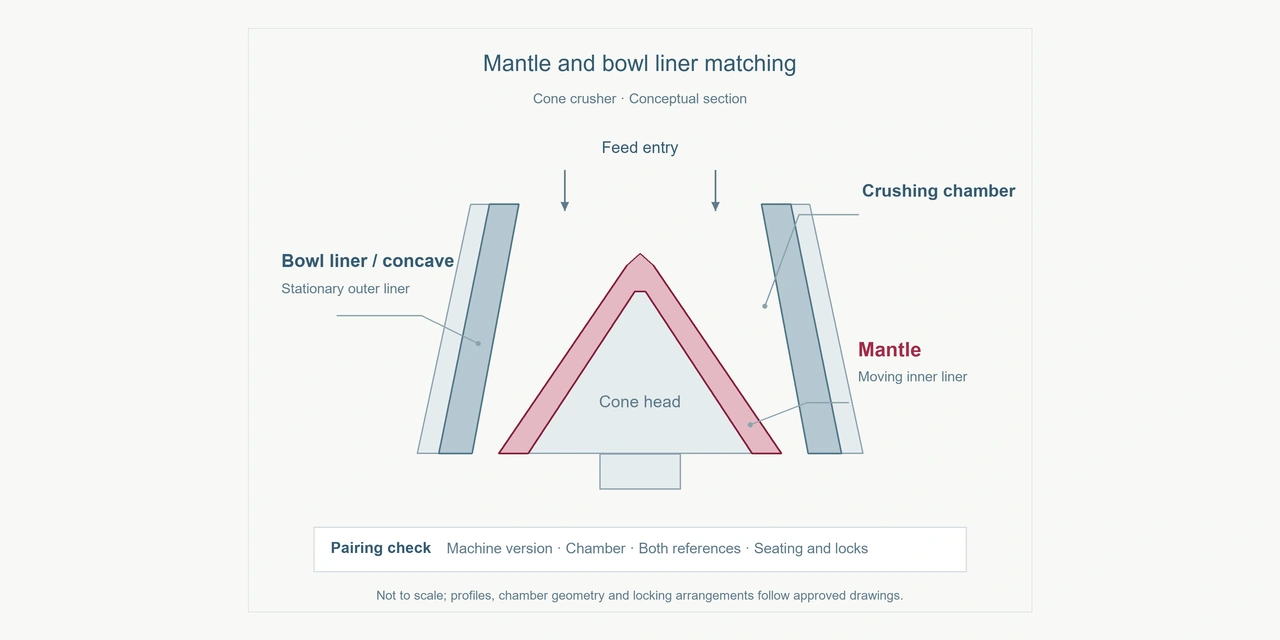
The mantle and stationary bowl liner together form a cone crusher’s crushing chamber. Before ordering, confirm the machine version, intended chamber, part or drawing references for both liners, and their seating, locating and locking interfaces. Even if you buy only one liner, provide the reference and condition of the liner that will remain installed.
The machine model is a useful starting point. A purchase specification also needs the chamber designation and part information applicable to that machine. You can start an enquiry with incomplete records, then establish the information needed for manufacture and installation before releasing production.
For the first contact, send the machine model, liner required, quantity and available part numbers, drawings or photographs. State whether the opposite liner will remain installed or be replaced. Include any confirmed chamber code, serial information and modification records.
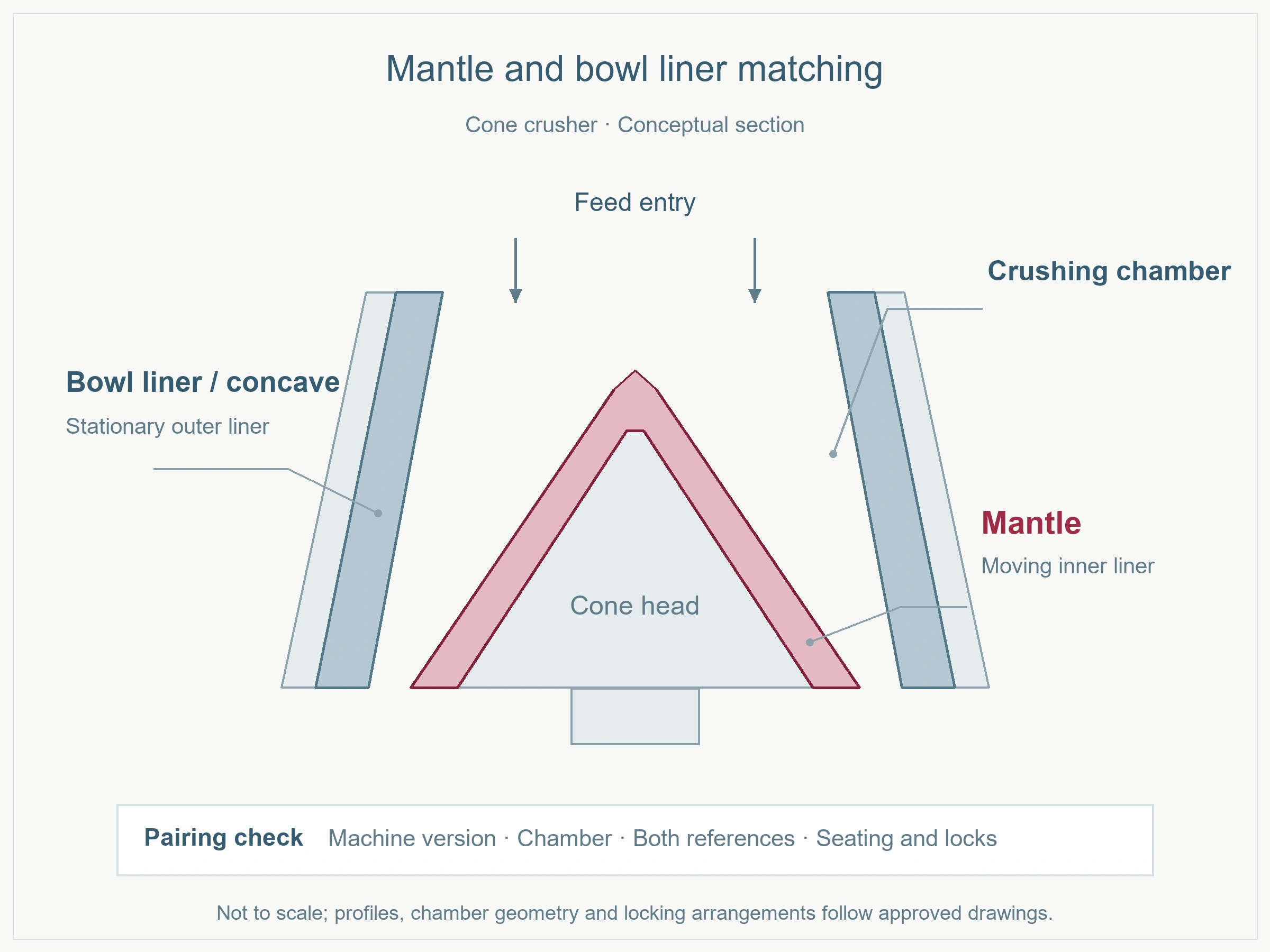
Figure 1. Mantle and stationary liner positions. Conceptual diagram, not to scale; actual profiles, chamber geometry and locking arrangements follow the approved drawings.
Identify the liners on both sides of the chamber
The mantle is the inner liner fitted to the cone head on the moving side. The concave or bowl liner is the outer, stationary liner. Their profiles form the crushing chamber together.
Use the names and references in the documentation for the actual machine. If the stationary liner consists of segments, record each segment’s identity, position and quantity.
When replacing one side, record the part reference and condition of the liner that will remain installed. When buying a complete chamber set, list both liner references and any associated components included in the supply.
Build a pairing record before comparing quotations
A pairing record connects the machine, both liners and the intended chamber. Start with the parts manual, approved drawings or previous purchase records that have been checked against the installed machine.
| Record | What the buyer should confirm |
|---|---|
| Machine identity | Manufacturer, model, serial number or applicable serial range |
| Installed configuration | Relevant head, bowl or housing version and recorded modifications |
| Chamber | Chamber designation or code in the applicable documentation |
| Mantle | Full part reference, drawing revision and installation position |
| Stationary liner | Full part reference and drawing revision; segment positions where applicable |
| Installation interfaces | Seating geometry and applicable locating and locking arrangements |
| Supply scope | Individual liner, liner pair and other accompanying components |
| Application | Feed description, known feed size, operating settings and current wear distribution |
When a supplier proposes an alternative, put the installed and proposed references in separate columns. This shows whether the offer restores the existing chamber or introduces a design change.
The following worksheet can be used to organise a quotation. It is a purchasing record format; the buyer and supplier fill it in using the actual parts and documents.
| Item | Installed or retained component | Proposed replacement |
|---|---|---|
| Mantle | Current part number, drawing and revision; replace or retain | Proposed part number, drawing and revision; quantity |
| Bowl liner or stationary liner | Current part number, drawing and revision; replace or retain | Proposed reference and revision; segment quantities if applicable |
| Chamber and interfaces | Current chamber code, seating and locking references | Retain the configuration, or list each change and its basis |
| Supply scope | Associated components that remain in use | Included components, separately purchased items and open questions |
If only the mantle is being replaced, assess the proposed mantle together with the retained bowl liner. Apply the same approach to a stationary-liner replacement by recording the retained mantle. Two individual quotations should be traceable to the same pairing record.
Resolve discrepancies between previous orders, drawings and casting marks in writing before confirming the purchase specification.
Establish whether you are restoring or changing the chamber
To preserve the existing chamber, confirm the approved part references and new-part geometry. Worn liners help identify the assembly and document wear, but their remaining profiles may differ from the original design.
For a chamber change, describe the current production problem and the intended result. Useful information includes feed size distribution, material characteristics, closed-side setting, target product grading and operating records.
Metso’s chamber-selection guidance considers feed, crusher settings, material, product requirements and operating speed. These factors provide context for evaluating a chamber change; the actual proposal still needs confirmation against the applicable machine and part documentation. Reference: Metso’s cone crusher chamber-selection guidance.
For a profile change, ask the supplier to identify the drawing basis and application assumptions. The quotation should state which existing references will be replaced and which interfaces or settings need further review.
Compare quotations against the same technical scope
Before comparing prices, check that the offers cover the same individual liner or liner combination, drawing revisions, material requirements, quantities and inspection scope.
The quotation should identify:
- The proposed mantle and stationary-liner part or drawing references.
- Chamber or profile designation and drawing revisions.
- Seating, locating and locking interfaces used for the fitment assessment.
- Material and inspection requirements for the actual parts.
- Any accompanying components included in the supply.
- Current technical assumptions and matters still awaiting confirmation.
A statement that a liner “fits the same machine model” may leave important details unresolved. An alternative proposal should describe its changes so the buyer can assess the scope and technical basis.
Start an enquiry when part numbers are missing
If you have drawings, send the files and revisions. Include available assembly information and state whether the drawings describe the installed parts or a proposed replacement.
If you have previous purchase records, provide references for both liners. Identify the machine where they were used and any later chamber change or machine modification.
If you have only worn liners or photographs, record the complete parts and key interfaces. Photograph casting marks, seating faces and locking arrangements. State the measurement position and units for dimensions you have checked. Record the installation positions of individual segments.
Photographs help identify the part family and the next questions to resolve. Before releasing the order, critical installation interfaces need a technical reference sufficient for manufacture and acceptance. Arrange photographs and measurements under the site’s safe maintenance procedures.
Connect fitment assessment with material selection
Once the parts and chamber are identified, describe the current liners’ service history: where wear is concentrated, any damage or movement, and changes to feed or operating conditions.
This information helps define the material discussion and inspection plan. The purchase specification should connect the agreed material to the particular part and drawing. Specify chemistry, hardness, dimensional checks and, where applicable, non-destructive testing for the order.
Deciding whether to replace one side or both requires review of machine requirements, the retained liner’s condition and the proposed combination. Base that decision on the applicable maintenance documentation and part records.
Send a cone liner enquiry that can be checked
Provide the machine model and serial information, available mantle and stationary-liner references, chamber code and quantities. Briefly describe the application. Attach drawings or photographs and identify anything still unconfirmed.
You can use this message to begin:
Machine manufacturer/model: ____; serial information, if available: ____; current chamber: ____. Replacement required: mantle/stationary liner/both; quantity: ____. References or drawing revisions for both installed liners: ____. Condition of retained components: ____. The aim is to preserve the chamber/evaluate a change, because: ____. Attachments and delivery destination: ____. Please use a pairing record to identify the proposed parts, accompanying components, design changes and open technical questions.
Send ZL your cone liner pairing and quotation information. Mark unknown information clearly, then resolve the relevant points before production is scheduled.